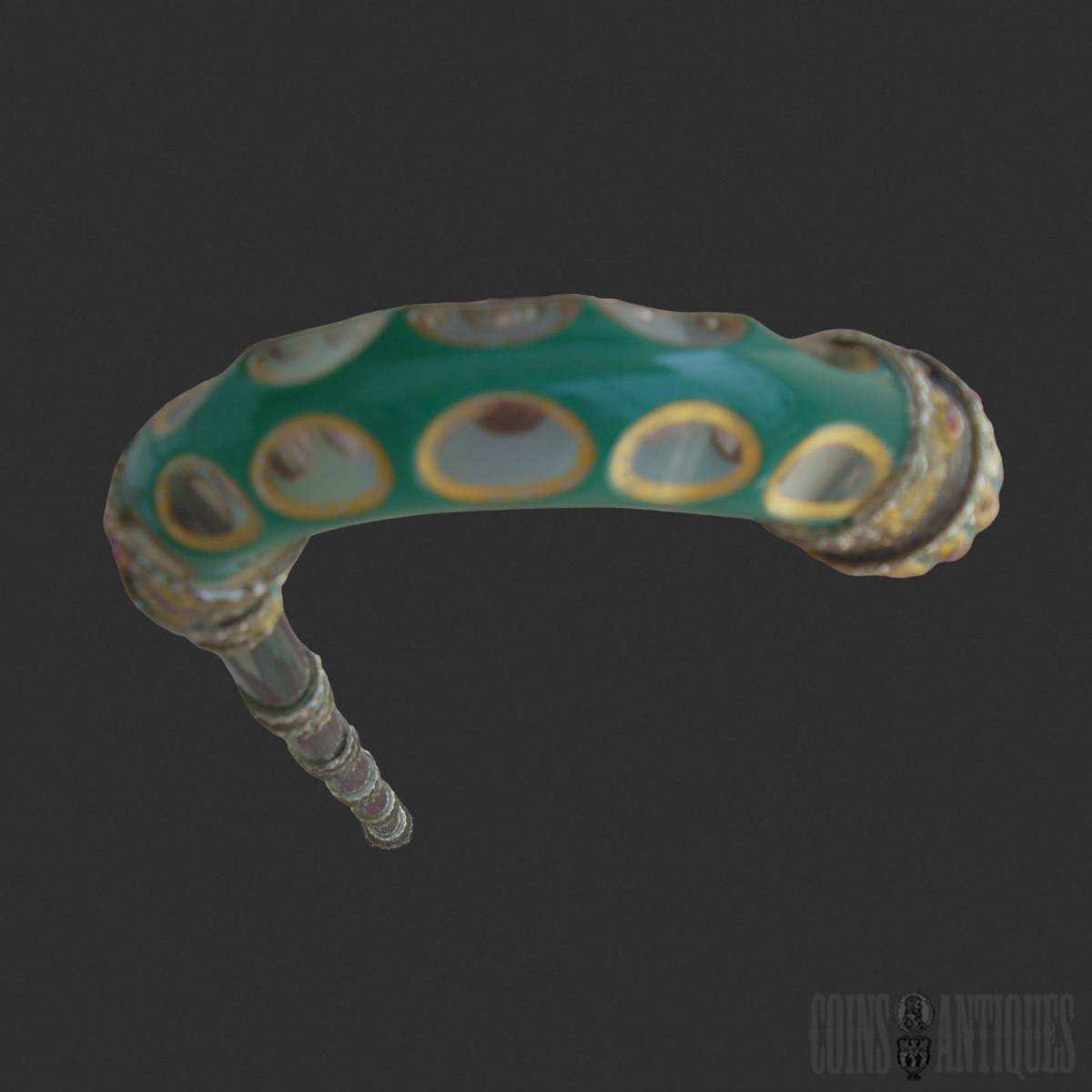


A Late 19th Century Indian Silver-Metal and Enamelled Glass Ceremonial Walking Cane
$ 1,500.00
This is a fine and highly decorative ceremonial walking cane, almost certainly of Indian origin, dating to the latter half of the 19th century. The piece is notable for its unusual construction, featuring a translucent green glass shaft and handle, lavishly mounted with enamelled and gem-set silver-metal. It represents a confluence of European form and traditional Indian craftsmanship, likely created for a high-status individual, be they local nobility or a European dignitary during the British Raj.
Period: Late 19th / Early 20th Century
Origin: Northern India, possibly Rajasthan or Lucknow
Dimensions: 98 cm × 16 cm (38.6 in × 6.3 in) | Length × Width
United States dollar ($)
The object is a ceremonial walking cane of exceptional visual appeal, constructed with a distinct shepherd’s crook handle. The entire body, comprising both the shaft and the handle, is fashioned from a continuous rod of substantial, translucent emerald-green glass. The quality of the glass is notable for its clarity and rich, uniform colour saturation.
The crook-shaped handle is ingeniously decorated with a series of circular, glass-filled apertures, each set within a fine silver-metal bezel. These “pools of light” create a captivating lensing effect, refracting light through the body of the handle. The pommel terminates in a bulbous, lobed finial of silver-metal, ornately worked with filigree and granulation. This terminal is further embellished with vibrant polychrome enamels, predominantly in yellow and green, and is set with a multitude of small, cabochon-cut red stones, which appear to be garnets or high-quality glass paste, alongside a collar of small, clear paste stones mimicking diamonds.
The junction between the handle’s curve and the vertical shaft is reinforced by a substantial silver-metal collar, constructed in three segments. This collar is richly decorated with repoussé and chased foliate and floral motifs against a stippled ground. Significant areas of yellow and blue polychrome enamel survive within the recesses of the design, highlighting the delicate artistry. The metalwork is bordered by finely worked rope-twist wires.
The long, cylindrical glass shaft is punctuated by two further decorative silver-metal bands, or ferrules, which match the design and execution of the main collar. These bands break the vertical line of the shaft, adding to the cane’s decorative rhythm and structural presence. The overall composition is one of opulent, meticulously detailed craftsmanship, designed to convey status and aesthetic sophistication.