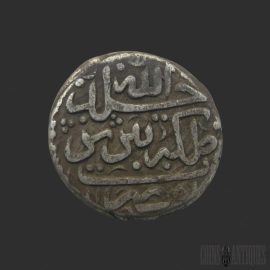
A rare and historically important silver dirham struck during the reign of al-Walid I (705–715 AD), one of the most influential rulers of the Umayyad Caliphate. This coin is dated AH 93 (711–712 AD) and was minted at Surraq, a lesser-known but significant mint associated with early Islamic administrative and economic activity.
This dirham belongs to the standardized Islamic coinage system established by Abd al-Malik ibn Marwan, which replaced earlier Byzantine and Sasanian-style coins with purely epigraphic designs. The coin features beautifully executed Arabic inscriptions in Kufic script, reflecting both religious devotion and centralized authority. The absence of imagery aligns with Islamic aniconic traditions, emphasizing textual expression over figural representation.
The obverse typically carries the Kalima (Islamic declaration of faith): “La ilaha illa Allah wahdahu la sharika lahu”, affirming the core belief of Islam. Surrounding inscriptions reinforce the Islamic identity of the state. The reverse generally includes Quranic phrases along with the mint name and the date (AH 93), serving as both a religious statement and an official record of issuance.
Coins from the Surraq mint are particularly scarce and sought after by collectors due to their limited production and relative rarity compared to major mints like Wasit or Kufa. Such issues provide valuable insight into the spread of Umayyad administrative structures and monetary control into regional centers.
The reign of al-Walid I was marked by rapid territorial expansion, including the Muslim conquest of the Iberian Peninsula and parts of Central Asia, as well as significant architectural achievements like the Great Mosque of Damascus. Coinage from this period reflects a unified economic system that supported governance across a vast and diverse empire.
Umayyad: Hisham, 724–743, AR Dirham AH113 al-Andalus (Spain)
Al-Hakam bin ‘Awana al-Kalbi, Umayyad Governor of Sindh under Caliph Hisham ibn ‘Abd al-Malik
Umayyad Caliphate, al-Walid I, AR Dirham, al-Taymarah, AH92, (710–711 AD)