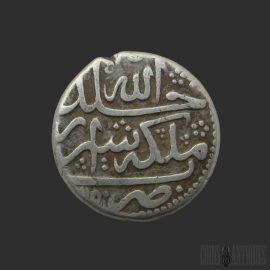
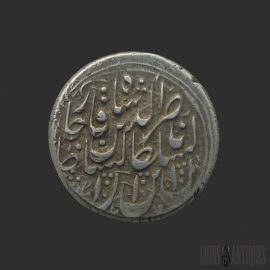
An important early Islamic silver dirham struck under the authority of Sulayman ibn Abd al-Malik (715–717 CE), a member of the ruling house of the Umayyad Caliphate. Dated AH 98 (716–717 AD), this piece was minted at Ardashir Khurrah—an important administrative and economic center in the province of Fars, corresponding to modern-day Firuzabad in Iran.
This dirham belongs to the fully developed phase of Islamic coinage reform initiated by Abd al-Malik ibn Marwan, in which earlier traditions of portraiture and symbolic imagery were abandoned in favor of purely epigraphic designs. The coin’s surfaces are covered with carefully structured Arabic inscriptions in Kufic script, presenting religious declarations and official minting information. The central inscriptions affirm the oneness of God and the prophethood of Muhammad, while the surrounding marginal legends typically incorporate Qur’anic text and the formal mint-and-date formula.
The mint of Ardashir Khurrah holds particular historical interest due to its roots in the pre-Islamic Sasanian period. Its continued use under Umayyad administration demonstrates how established regional infrastructures were adapted to serve the expanding Islamic state. Coins produced here illustrate the blending of administrative continuity with new ideological and artistic directions introduced by Islamic governance.
Issued during a time when the Umayyad Empire spanned vast territories from the Middle East to North Africa, dirhams such as this played a crucial role in facilitating long-distance trade and maintaining economic cohesion. The late 1st century AH marks a mature phase of monetary standardization, and coins from this era are valued for both their historical context and their refined calligraphic style.
This particular specimen shows signs of circulation, including moderate wear across the fields and legends, along with natural toning and minor surface deposits accumulated over centuries. These characteristics are typical for coins of this age and contribute to its authenticity. Despite wear, enough detail remains visible to confirm its attribution, preserving its appeal for collectors and scholars alike.
Umayyad Caliphate, al-Walid I, AR Dirham, al-Taymarah, AH92, (710–711 AD)
Umayyad: Hisham, 724–743, AR Dirham AH113 al-Andalus (Spain)
Al-Hakam bin ‘Awana al-Kalbi, Umayyad Governor of Sindh under Caliph Hisham ibn ‘Abd al-Malik